Albania
 Argentina
 Australia
 Austria
 Belgium
 Bosnia and Herzegovina
 Brazil
 Bulgaria
 Canada
 Chile
 Colombia
 Croatia
 Czech Republic
 Denmark
 Estonia
 Finland
 France
 Germany
 Greece
 Hungary
 Ireland
 Italy
 Latvia
 Lithuania
 Luxembourg
 Mexico
 Moldova
 Montenegro
 Netherlands
 New Zealand
 North Macedonia
 Norway
 Philippines
 Poland
 Portugal
 Romania
 Serbia
 Slovakia
 Slovenia
 South Africa
 Spain
 Sweden
 Switzerland
 Turkey
 Ukraine
 United Kingdom
 United States of America


Recorders
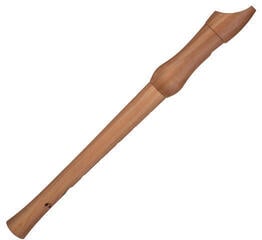
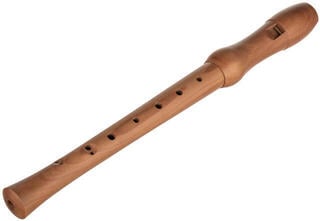
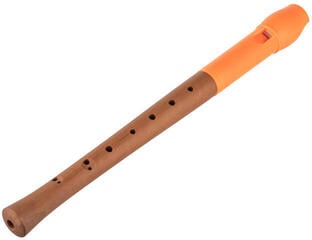
The recorder is not just a school instrument: the family ranges from sopranino to bass and is used in early, chamber and folk music. The size determines the register, hole spacing and amount of air required. Choose the material and fingering only after you know whether the recorder will be used by a child at school, an adult beginner or a player in an ensemble.
Register according to the role in the music
The soprano recorder is the most common choice for your first lessons. The alto recorder sounds lower and uses different basic fingering; tenor and bass recorders add the lower voices in an ensemble. The pan flute has a different construction and playing technique, so you will find it separately among pan flutes.
German or Baroque fingering
When buying for school, follow your teacher's requirements. German fingering makes some first notes easier, while Baroque fingering is widespread in further study and supports chromatic playing more accurately. You can distinguish them by the manufacturer's marking and the shape of the holes; the colour of the instrument tells you nothing.
Plastic withstands school use, while wood needs time
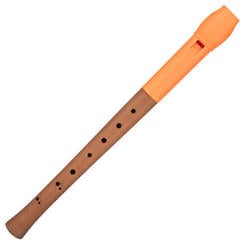
A plastic model is easy to clean and withstands moisture consistently. You need to play in a wooden recorder gradually, dry it after playing and protect it from sudden temperature changes. Oil it only if the wood and method are approved by the manufacturer.
Your finger reach is the practical limit
With an alto or tenor, check whether you can cover the holes with the pads of your fingers without tension. Keys can make the holes on a larger instrument easier to reach. If air escapes from one hole, the result is squeaking or an uncertain note, not a tuning fault.
An ensemble needs a balanced range of sizes
The soprano carries the high melody, the alto is often the middle of the consort, the tenor adds a mellow lower voice and the bass provides the foundation. When buying instruments together, look for the same pitch standard and compatible fingering. A random mixture of school and historical models may differ in both intonation and volume.
Two-piece and three-piece bodies
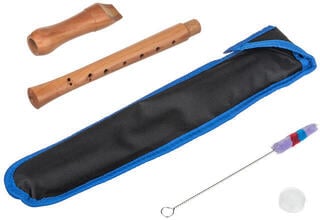
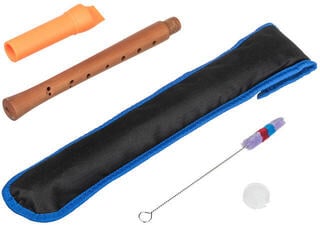
More sections make cleaning easier and allow you to rotate the lower section to suit your little finger. However, the joints must be neither loose nor excessively tight. A cork joint needs a small amount of suitable grease; treat a plastic joint according to the manufacturer's instructions and do not automatically lubricate it.
Clear a blocked windway by drying it
During long playing sessions, condensation may impair the attack of notes. Do not blow forcefully into the labium or insert a sharp object into the windway. Let the instrument drain, dry it carefully and, with a wooden model, give the body a rest so that the moisture is not distributed unevenly.
Match the size and fingering to the textbook or ensemble, then decide between practical plastic and more sensitive wood.