Albania
 Argentina
 Australia
 Austria
 Belgium
 Bosnia and Herzegovina
 Brazil
 Bulgaria
 Canada
 Chile
 Colombia
 Croatia
 Czech Republic
 Denmark
 Estonia
 Finland
 France
 Germany
 Greece
 Hungary
 Ireland
 Italy
 Latvia
 Lithuania
 Luxembourg
 Mexico
 Moldova
 Montenegro
 Netherlands
 New Zealand
 North Macedonia
 Norway
 Philippines
 Poland
 Portugal
 Romania
 Serbia
 Slovakia
 Slovenia
 South Africa
 Spain
 Sweden
 Switzerland
 Turkey
 Ukraine
 United Kingdom
 United States of America


Studio Acoustic Elements
Studio acoustic treatment controls reflections and reverberation in a room, helping you make recording and mixing decisions based on the signal you hear rather than the room's coloration. Panels, bass traps and diffusers address different problems and do not replace soundproofing against neighbours or street noise. Before buying, measure the room, listen from several positions and mark first-reflection surfaces. The best starting point is usually targeted treatment of a specific problem rather than covering every wall.
Identify the room's problem first
| Symptom | Suitable approach | Placement note |
|---|---|---|
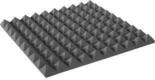
| Short echoes and harsh reflections | Acoustic absorption panels | First-reflection points on side walls and the ceiling |
| Boomy or uneven bass | Bass traps | Often corners and areas where low-frequency energy builds up |
| The room is too dead, but reflections remain uneven | Diffusers | Require a suitable listening distance and considered positioning |
| Recording voice without permanent treatment | Portable reflection filter | Behind the microphone, it reduces some surrounding reflections rather than treating the whole room |
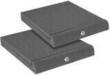
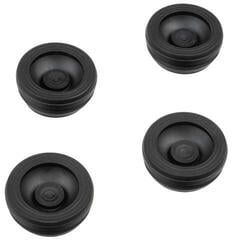
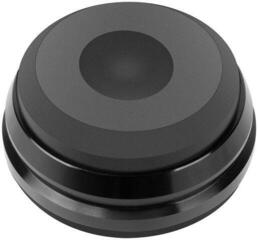
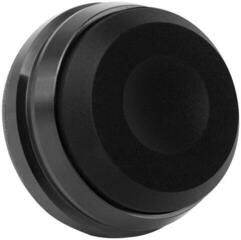
| Monitors transmit vibrations to the desk | Isolation pads | Under each monitor, with safe load capacity and tilt |
Absorption, diffusion and isolation
Absorption panels
A porous panel turns some sound energy into heat and reduces reflections, particularly in the frequency range suited to its thickness and material. A thicker panel or an air gap behind it can extend its effect to lower frequencies than a thin layer glued directly to a surface. You cannot judge performance by the appearance or name of the foam alone. Look at the available absorption data, thickness, dimensions and mounting method.
At the mixing desk, focus on first reflections from the side walls, the ceiling above the desk and the wall behind the speakers or listener, depending on the room's geometry. The mirror method can help locate a reflection point: a helper moves a mirror along the wall while you mark the position where you can see the relevant monitor from your listening position. This is a practical aid rather than a measurement of the room's entire acoustics.
Bass traps
Low frequencies create pronounced peaks and dips in a small room. Bass traps are often placed in corners, where surfaces meet and there is usually room for thicker absorption. A single unit may not solve the problem throughout the room, so check the result both at and away from the listening position. EQ can reduce some peaks, but cannot fill an acoustic null or shorten long reverberation.
Diffusers
A diffuser does not scatter sound at random: its shape is designed for a particular frequency range and distance. It helps retain a livelier feel without a single strong specular reflection. In a cramped room, the listener may be too close for the scattered sound field to develop properly. Consider diffusion after bringing first reflections and low frequencies under control.
Getting started in a home studio
- Measure the room's length, width and height, and draw in doors, windows, radiators and furniture.
- Position the desk and listening setup symmetrically relative to the side walls if the layout allows.
- Set up your studio monitors according to the manufacturer's recommendations and isolate them from the work surface.
- Listen to a familiar recording and note boominess, harsh reflections and changes as you move your head.
- Treat first reflections and accessible corners first, then listen or measure again.
- Add further treatment in stages so you know what has actually changed.
An empty room with a hard floor, bare walls and a desk behaves differently from a furnished room. A carpet mainly absorbs higher frequencies and will not solve bass resonances on its own. A bookcase may break up some reflections, but is not a calculated diffuser. Curtains can help around glass depending on their material and folds, so do not judge their effect by appearance alone.
Recording voices and instruments
A portable filter behind the microphone reduces some sound that would otherwise travel from the area behind the microphone to surrounding surfaces and return. It does not stop outside noise or create an isolated booth. When recording, also try changing the performer's position and the microphone's orientation relative to the walls. A small move can affect reflections more than another thin layer of foam.
Too much absorption only around the microphone can leave dull highs and an untreated low end. Aim for a balance of coverage, thickness and placement instead. With loud instruments, also consider vibration transmission through the floor and structure; this is a different discipline from treating sound inside a room.
Materials, mounting and safety
- Thickness and density: assess them alongside the construction and stated acoustic performance, rather than as a guarantee on their own.
- Dimensions: determine the covered area and number of joints. Leave ventilation clear and retain access to equipment when planning.
- Fixing: adhesive is more permanent, while a frame or stand can be moved. The supporting surface must carry the treatment's weight.
- Fire performance: check the documentation for the specific product, particularly in public or commercial spaces.
- Maintenance: fabric finishes, foam and wooden diffusers need different cleaning methods; follow the manufacturer's instructions.
Before gluing, check that the adhesive suits both the panel and the plaster, and plan the layout with a dry run. Secure heavy panels to the supporting surface using a method appropriate to their weight. A freestanding panel lets you change the recording layout, but must remain stable and must not restrict safe passage.
Checking the result
Check changes using the same recording, at the same volume and from the same position. A handclap reveals obvious short echoes, but does not give an accurate picture of low-frequency behaviour. A measurement microphone and suitable software provide more detailed data, which also needs correct interpretation. If you are setting up a room from scratch or addressing a serious bass problem, consulting an acoustician can prevent buying treatment for the wrong location.
A compact home workspace does not need to copy a large studio. What matters is a repeatable listening position, reasonably balanced left and right sides, and treatment that addresses an audible or measured problem. This lets you retain a lively room while reducing reflections that mask detail in recordings.